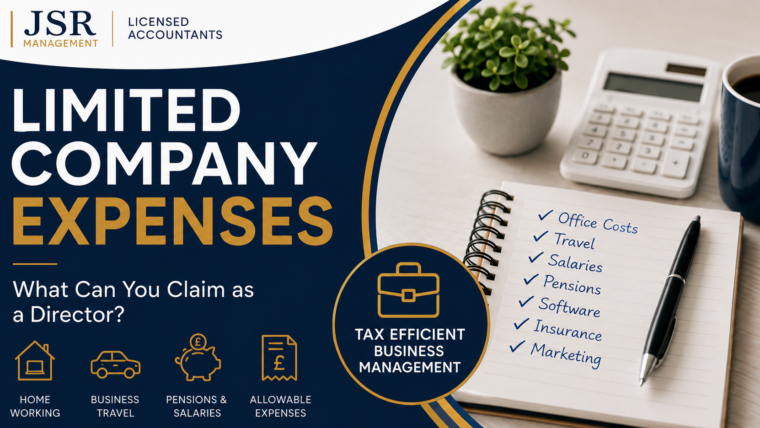
All about expenses for your business and the taxation (direct or indirect) that we pay!
As business owners, we all spend money on items to keep the business running, however what effect does this really have on the Financial Statements of the business and the tax (whether direct or indirect) we are required to pay to HMRC?
Looking at indirect tax, your VAT liability is calculated by taking your output tax (Sales Tax) and deducting your input tax (Purchase VAT) to give you a figure that you need to pay (or, if your Input Tax Claim is more – will be refunded) by HMRC. There are different VAT rates on your purchases such as standard rate 20%, reduced rate of 5%, zero rated 0%, exempt or outside the scope of VAT altogether. Care should be taken to ensure that the correct VAT rate is claimed through your books and records.
HMRC will often complete compliance checks on VAT returns to ensure that compliance with the rules are adhered to. There are legal guidelines as to which goods are eligible however it is common place with tax law, that there are also grey areas which can create issues for businesses, when their current VAT treatment of products or purchases are challenged or reviewed.
Just to note – there are various VAT schemes including FRS, where the rules change, plus there are rules on how much turnover can be generated to remain within these schemes, we will expand on this in another article!
If you are VAT registered and your expense meets the criteria below, you can claim back the VAT, and this will have the effect of reducing your VAT liability to HMRC, or increasing your VAT reclaim.
- The purchase must be wholly, exclusively, and necessary for the running of the business.
- You have the supporting documentation/invoices – this means the correct VAT invoice/receipt.
- The expense is a vatable supply, and the supplier is VAT registered.
As exampled below with a VAT liability of £1000 from Sales, claiming back the following purchase VAT will reduce this liability to £974.00:
| Description | Net Amount | Gross Amount | VAT Rate | VAT Claimed |
| Mobile Phone | £40 | £50 | 20% | £10 |
| Screwdriver | £10 | £12 | 20% | £2 |
| Diesel | £70 | £84 | 20% | £14 |
| Total = £26 |
You can see how the small purchases you make day by day can add up and help to reduce your payments to HMRC.
There are advantages and disadvantages of being VAT registered, if you do not meet the threshold (currently £85,000 turnover), and decide you want to be VAT registered – you can voluntarily register for VAT purposes.
Some advantages could be:
- It makes your business look larger than what it actually is, creating a positive image.
- If your sales are mainly zero rated or your fall within DRC – it allows you to reclaim the input tax, thereby helping with cashflow.
- VAT registration can enhance your competitiveness within the market and promote your market share.
- You will not need to monitor your sales to ensure compliance with the VAT threshold, not to VAT register when required can bring huge penalties, legal consequences, and financial setbacks.
Some disadvantages could be:
- Additional administration burden
- Impact on pricing when it comes to your customers – some of which may not be VAT registered and may not approve of an additional 20% increase in the prices being charged.
- Unexpected VAT bill – some VAT registered businesses do not save the VAT amount, so when it comes to the quarterly bill this can put financial stress on the cash flow.
- Complexity of the VAT legislation.
- Risk of VAT compliance checks.
Not only do business expenses reduce your VAT liability, but, if fully allowable and expensed to your profit and loss, these will also reduce your taxation at the end of the year as they will decrease your profits. There are two separate types of expenses, and they have different effects within your business:
- Capital
- Revenue
Do you know the difference between revenue and capital expenditure?
- Capital – a one-time purchase of an asset, which will have an enduring benefit to the business, for a period longer than 12 months. This is a tangible resource that you use to help you run your business to generate income.
- Revenue – these are smaller purchases in a business and are the ongoing, short-term expenses used for day to day running, generally the benefit of which is utilised within 12 months of purchase.
Revenue expenses are those that sit on the profit and loss/income statement, reducing profit and your taxation. Some of this revenue expense when we come to taxation workings, can be allowable or disallowable, care should be taken when deciding what to allow and what to disallow.
Capital expenditure sits on the balance sheet – it only reduces the taxable profits of the business provided that the capital expenditure attracts capital allowances. We will be releasing an article on capital allowances at a later date!
We hope you have found this article useful, contact us to learn more!
Email: accounts@jsrmanagement.co.uk
Telephone: 02380 323846
Unsure about Claiming expenses for your business? Get in touch