

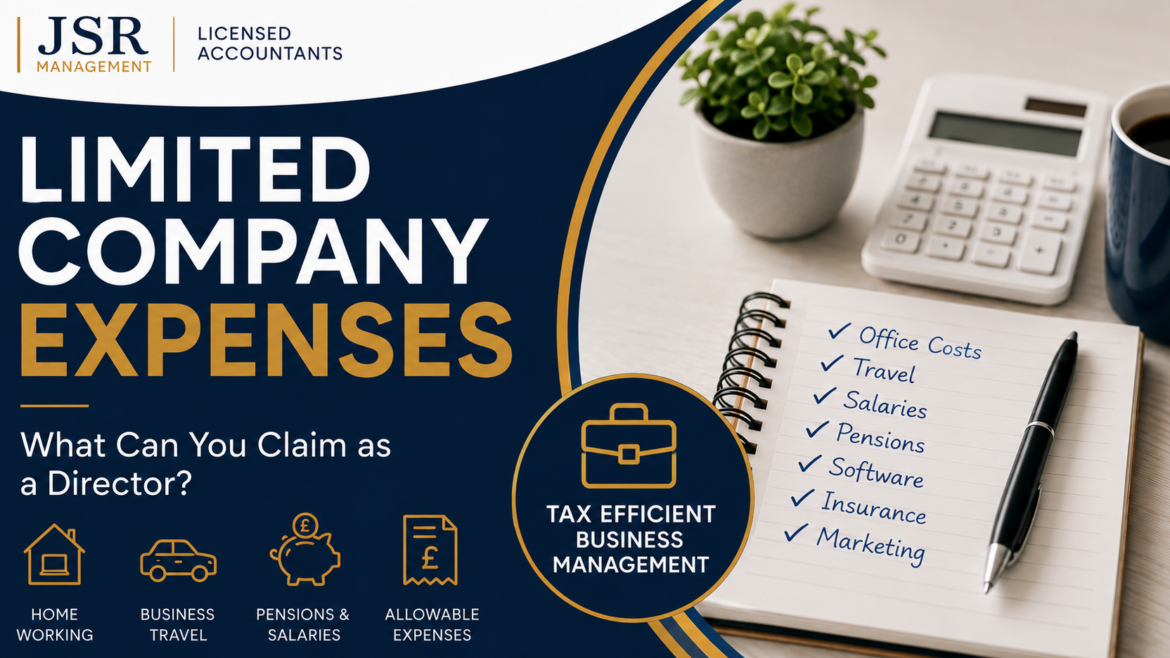
Running a limited company comes with plenty of financial responsibilities, but it can also provide opportunities to manage your business finances more tax efficiently.
One of the most common questions we hear from limited company directors is:
“What expenses can I actually claim through my limited company?”
Understanding allowable business expenses is important. Claiming legitimate expenses can reduce your company’s taxable profit and therefore potentially reduce the amount of Corporation Tax payable.
However, not every purchase can simply be put through the company.
In this guide, we explain some of the common expenses a UK limited company may be able to claim, what directors need to consider and why good record keeping is essential.
What Is an Allowable Limited Company Expense?
Generally, a business expense must have been incurred wholly and exclusively for the purposes of the business to qualify for Corporation Tax relief.
In simple terms, the expense needs to have a genuine business purpose.
For example, paying for accounting software used to manage your company’s finances would ordinarily have a clear business purpose.
Paying for your personal weekly food shop would not.
Some expenses have both business and personal elements, which can make the rules more complicated. This is where speaking to an accountant can help you understand what can legitimately be claimed.
How Do Business Expenses Affect Corporation Tax?
Allowable business expenses can generally be deducted when calculating your company’s taxable profit.
For example, if your company generates £100,000 in income and has £30,000 of allowable expenses, its accounting and taxable profit calculations will take those expenses into consideration.
Corporation Tax is then calculated based on the company’s taxable profits after the appropriate adjustments, reliefs and allowances have been applied.
This is one reason accurate bookkeeping is so important.
If legitimate expenses are missed or recorded incorrectly, your company could potentially pay more tax than necessary.
Common Expenses Limited Companies Can Claim
The exact expenses available will depend on what your business does, but there are several common areas directors should be aware of.
Accountancy and Professional Fees
Fees paid for professional services required by the business can often be claimed as a business expense.
These might include:
- Accountancy fees
- Bookkeeping services
- Legal fees relating to the business
- Business consultancy
- Professional subscriptions
There can be exceptions depending on the nature of the professional service, so individual circumstances should always be considered.
Business Software and Subscriptions
Many modern businesses rely on software to operate effectively.
Allowable costs may include subscriptions for:
- Accounting software
- CRM systems
- Project management tools
- Cloud storage
- Design software
- Video conferencing platforms
- Business email
- Industry-specific software
If the subscription is being used for legitimate business purposes, it may qualify as an allowable expense.
Office Costs
Everyday costs associated with running your office or workspace may also be allowable.
Examples can include:
- Stationery
- Printing
- Postage
- Office equipment
- Printer ink
- Business telephone costs
- Internet costs
The rules can become more complicated when something is used for both business and personal purposes, so it is important to correctly identify the business element.
Working From Home
If you run your limited company from home, the company may be able to contribute towards certain home-working costs.
There are different ways this can be approached depending on your circumstances.
Directors should be careful about simply allocating large household expenses to the company without understanding the tax implications.
Speak to your accountant about the most appropriate method for your circumstances.
Business Travel
Travel undertaken wholly for business purposes may qualify as an allowable expense.
This could include:
- Train fares
- Flights
- Taxis
- Parking
- Hotel accommodation
- Business mileage
However, ordinary commuting between your home and a permanent workplace is generally treated differently.
Travel expense rules can become particularly important for directors who work at multiple locations or regularly visit clients.
Keeping accurate mileage and travel records can make calculating these expenses considerably easier.
Mileage When Using Your Own Car
If you use your personal vehicle for qualifying business journeys, your limited company may be able to reimburse you using HMRC’s approved mileage rates.
You should keep records showing information such as:
- The date of the journey
- Where you travelled
- The business purpose
- The number of business miles travelled
Accurate mileage records provide evidence to support the reimbursement if required.
Mobile Phones
A mobile phone provided to a director or employee by the company may potentially be treated differently from simply reimbursing the cost of a personal mobile phone contract.
How the contract is structured and who it is between can therefore matter.
If you use your phone extensively for business, it is worth discussing the arrangement with your accountant rather than assuming the entire personal bill can automatically be claimed.
Director Salaries, National Insurance and Employment Allowance
If your limited company employs people, salaries and certain associated employment costs will generally form part of the company’s expenses. This can include a director’s salary where the director is employed by the company.
How a director’s salary is structured can also form an important part of tax planning.
For the 2026/27 tax year, the Lower Earnings Limit is £125 per week or £541.67 per month. Paying a salary at or above the relevant level can help a director build qualifying National Insurance credits towards benefits such as their State Pension.
Depending on the company’s circumstances, it may also be possible to make use of the Employment Allowance, which can reduce an eligible employer’s Class 1 National Insurance liability by up to £10,500 for the 2026/27 tax year.
A company where the director is the only employee liable for employer’s Class 1 National Insurance will generally not qualify for Employment Allowance. However, where the company has another employee who meets the relevant requirements, the position can be different.
For example, a company with an additional employee earning at or above the Lower Earnings Limit may potentially be able to include the director’s employer National Insurance liability within an Employment Allowance claim, provided the business meets HMRC’s eligibility criteria.
A director’s salary can therefore have wider implications than simply determining how much money they receive each month. The appropriate salary level can affect:
- Corporation Tax
- Employer and employee National Insurance
- Employment Allowance
- Personal Income Tax
- National Insurance credits towards the State Pension
- The overall balance between salary and dividends
The most tax-efficient approach will depend on the company and director’s individual circumstances. Director remuneration should therefore be reviewed regularly rather than assuming the same salary and dividend structure will remain appropriate from one tax year to the next.
Pension Contributions
Employer pension contributions made by a limited company can potentially be a tax-efficient way for directors to save for retirement.
Company pension contributions may qualify as an allowable business expense for Corporation Tax purposes, subject to the relevant conditions.
There are also pension contribution limits and individual circumstances to consider, so professional advice is recommended before making significant contributions.
Training and Professional Development
Training costs can sometimes be claimed where they relate to the director or employee’s existing business activities.
For example, training that updates or improves skills required for the work your company already performs may potentially qualify.
Training undertaken to establish an entirely new trade or profession may be treated differently.
The purpose and nature of the training are therefore important.
Business Insurance
Insurance policies taken out specifically for the company may normally be treated as business expenses.
Examples might include:
- Professional indemnity insurance
- Public liability insurance
- Employer’s liability insurance
- Business equipment insurance
- Relevant specialist industry cover
The policies required will depend on the nature of your business.
Marketing and Advertising
Costs incurred promoting your business can generally be legitimate business expenses.
These may include:
- Website costs
- SEO services
- Google Ads
- Social media advertising
- Graphic design
- Printing
- Brochures
- Networking fees
- Sponsorship in appropriate circumstances
The expense should relate to promoting the business rather than providing a personal benefit to the director.
Trivial Benefits
Limited companies may also be able to provide certain trivial benefits to employees and directors without creating a tax liability, provided HMRC’s conditions are satisfied.
For a benefit to qualify as trivial, specific rules apply regarding its value, whether it is cash or a cash voucher, why it has been provided and whether it forms part of the person’s employment contract or remuneration.
Additional limits can apply to directors of close companies.
Trivial benefits are an area that is easily misunderstood, so it is important to ensure the rules are followed correctly.
Annual Staff Events
Limited companies may potentially receive tax relief for qualifying annual staff events, such as a Christmas party.
There is an exemption of up to £150 per head per tax year, provided the relevant conditions are met.
It is important to understand that this is an exemption rather than simply a £150 allowance that directors can withdraw or spend personally.
If the qualifying conditions are not met, the tax treatment may be different.
Business Gifts
Some business gifts may be allowable, but there are specific rules surrounding what qualifies.
Items containing prominent business advertising may be treated differently from ordinary gifts, and there are limits and exclusions to consider.
If your company regularly gives gifts to clients or suppliers, speak to your accountant about the correct tax treatment.
Benefits in Kind
Limited companies can provide directors and employees with certain benefits, but some will need to be reported to HMRC and may create additional Income Tax or National Insurance liabilities.
These are commonly known as Benefits in Kind.
Examples can include:
- Company cars
- Private medical insurance
- Certain loans
- Other personal benefits provided by the company
Providing something through the company does not automatically make it tax free.
The overall tax position needs to be considered.
Entertainment Expenses
Business entertainment is an area where directors frequently become confused.
Your company may pay for certain business entertainment costs, but that does not necessarily mean the expense qualifies for Corporation Tax relief.
There are different rules for entertaining clients compared with entertaining employees.
Keeping clear records showing who attended and the business purpose of the expense is important.
Can I Claim Personal Expenses Through My Limited Company?
Generally, no.
A limited company is legally separate from its directors and shareholders.
Company money therefore does not simply belong to the director personally.
If the company pays for something that is primarily personal, there may be tax consequences and the transaction may need to be treated as:
- Salary
- A benefit in kind
- A dividend
- A director’s loan
depending on the circumstances.
This is one of the biggest differences between operating through a limited company and simply managing your own personal finances.
Why Keeping Receipts and Accurate Records Matters
Claiming allowable expenses is only one part of the process.
Your company also needs accurate financial records to support those transactions.
Good bookkeeping should record:
- What was purchased
- When it was purchased
- How much was paid
- Who was paid
- The business purpose
- Relevant receipts or invoices
Maintaining these records throughout the year makes preparing annual accounts and Corporation Tax returns much easier.
It can also give directors a far clearer picture of how their business is actually performing.
Are Limited Company Expenses Different From Sole Trader Expenses?
There are similarities, but the rules are not identical.
A limited company is a separate legal entity, whereas a sole trader and their business are legally the same person.
Limited companies can therefore have access to certain arrangements that do not apply to sole traders in the same way, including areas such as:
- Director payroll
- Certain trivial benefits
- Annual staff events
- Employer pension contributions
- Some Benefits in Kind
However, operating through a limited company also brings additional responsibilities and reporting requirements.
This is why tax efficiency should never be considered in isolation when deciding whether to incorporate.
Frequently Asked Questions About Limited Company Expenses
What expenses can a limited company claim?
A limited company can generally claim legitimate business expenses incurred wholly and exclusively for business purposes. These may include accountancy fees, software, office costs, qualifying business travel, insurance, marketing and certain employment costs. The tax treatment will depend on the individual expense and circumstances.
Can I claim my lunch through my limited company?
Not necessarily. Ordinary meals are generally considered personal expenditure, although food costs may be allowable in certain qualifying business travel circumstances. The reason for the expense is important.
Can my limited company pay for my mobile phone?
Potentially, yes. The tax treatment can depend on how the mobile phone contract is structured and whether it is provided by the company.
Can I claim for working from home?
A limited company may be able to reimburse certain home-working costs, but specific rules apply. Your accountant can advise on the appropriate approach for your circumstances.
Can my limited company pay into my pension?
Yes, employer pension contributions can potentially be made by a limited company and may be tax efficient, subject to the relevant rules and individual circumstances.
Can I claim for a Christmas party?
Qualifying annual staff events can potentially benefit from an exemption of up to £150 per head per tax year, provided the necessary conditions are met.
Can a director’s salary reduce Corporation Tax?
A director’s salary and certain associated employment costs can generally be business expenses when calculating company profits, subject to the relevant tax rules. However, salary can also have Income Tax and National Insurance implications, so the overall position should be considered.
Can a limited company claim Employment Allowance?
Eligible employers may be able to reduce their employer Class 1 National Insurance liability through Employment Allowance. A company with only one director who is the sole employee liable for employer’s Class 1 National Insurance generally cannot claim, but the position can change where there are other qualifying employees.
Does paying myself a salary help towards my State Pension?
A director receiving earnings at or above the relevant National Insurance threshold may be able to build qualifying National Insurance credits towards their State Pension, even where little or no employee National Insurance is actually payable. The appropriate salary level should be reviewed for each tax year.
Can I put personal purchases through the company?
Personal expenses should not simply be recorded as business expenses. If a company pays a director’s personal costs, there can be tax and accounting consequences.
Do I need to keep receipts for limited company expenses?
You should maintain appropriate records and evidence supporting business expenses. Good digital record keeping also makes bookkeeping, year-end accounts and Corporation Tax preparation considerably easier.
Are You Claiming Everything Your Limited Company Is Entitled To?
Missing legitimate expenses could mean your company pays more tax than necessary. Claiming something incorrectly, however, can create problems with your accounts and HMRC.
The goal isn’t simply to claim as much as possible.
It’s to understand what your company can legitimately claim and structure your finances in a way that is both compliant and tax efficient.
At JSR Management, we support limited companies in Southampton and across the UK with bookkeeping, Corporation Tax, payroll, VAT, tax planning and ongoing accountancy.
Our team can review how you’re currently managing your company finances, identify areas you may be overlooking and help ensure your records and tax position are managed correctly.
Book a Free Consultation With JSR Management
If you’re unsure which expenses your limited company can claim, how best to pay yourself as a director or whether your business is operating tax efficiently, we’re here to help.
Book a free accounting and tax consultation with JSR Management today and get practical advice tailored to you and your business.
Use the online booking calendar HERE to select a convenient time.
Alternatively you call us on 02380 323846 or drop us an email HERE
